Geometric Ornament for Digital Typesetting
by Spencer Scorcelletti
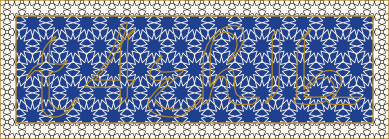
The word Tazhib (تذهيب) refers to the The Classical Islamic style of manuscript illumination. The t4zh1b library is an effort to emulate some of these patterns for the purpose of typesetting. Read on to learn more or see the demo.
Tilings, Rays, and Patterns
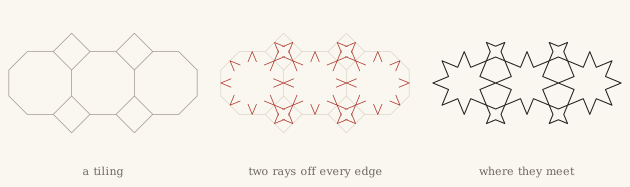
The process begins with a tiling, which is just repeating shapes to cover a geometric plane. Rays then are imaginary lines that symmetrically emanate from each edge of the tiling’s shapes. When rays intersect with one another they form patterns. The resulting patterns are the ornament.
By starting with different tilings one can produce different patterns. Below are square, hexagonal, octagon–and–square, and dodecagon–and–triangle tilings.
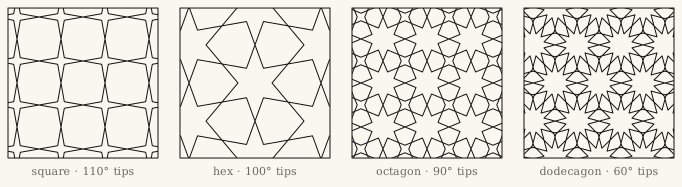
The angle of the tips of the patterns is determined by the following formula:
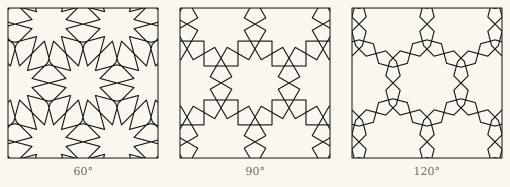
tip = 180° + 360/n − 2 × contact
Hatching, Color, and Materials
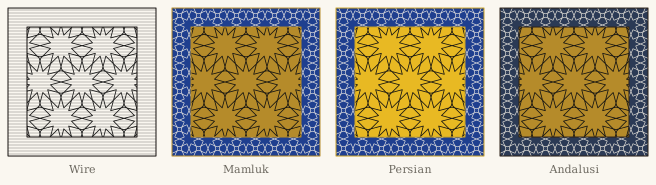
Before print publishing was wide spread there were pre-established conventions for representing certain colors with hatching. Both are supported here.


Additionally there can be ornate materials used within ornament. The three blue hues below are distinct and reflect different regions and centuries.
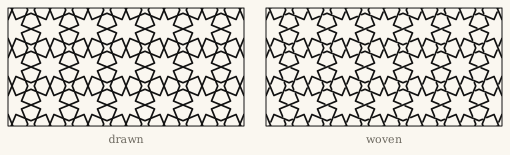
Strapwork refers to a ribbon either drawn or woven over and under, acting as a continuous, unbroken line. Along any strand the crossings must alternate, with each crossing binding the two strands.
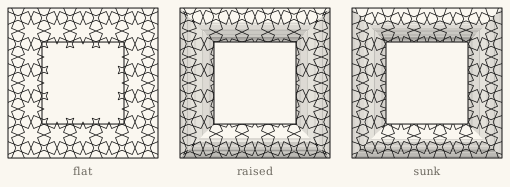
Depth and Shading
The patterns can be quite overwhelming when rendered in 2d. Therefore, like their architectural counterparts, they can be made concave or convex. With depth shading then becomes possible.
Lettering and Furniture
A common need when typesetting is to have some kind of ornamented letters.
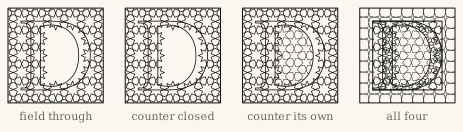
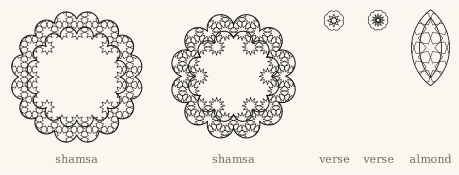
Additionally shamsas, verse markers, and marginal almonds can be formed.
Everything at once
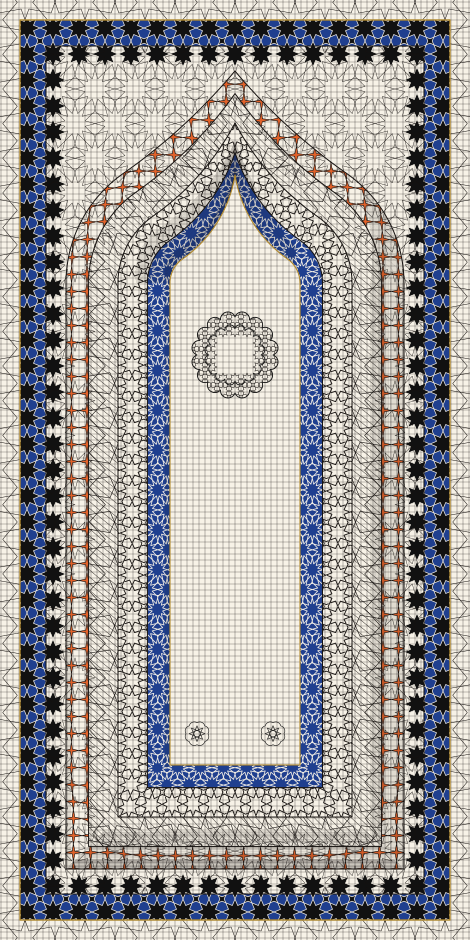
These elements combined can make interesting and historically accurate ornament. Below is a tall ogee window, with four rings of ornament, standing in relief off a bordered outline: lapis reversed, gold stipple woven, two rings left in diagonal hatching, red lead two-toned, with a shamsa and two verse markers in the opening.
The generator is t4zh1b, MIT licensed, with no dependencies. Everything above is a scalable vector graphic (SVG). It was built for work towards typesetting this club’s own edition of the Arabian Nights.
Contextual Relations
Refers To
References Commentary
- (none)
Refrenced by Commentary
- (none)
Comments # (0)
Comment